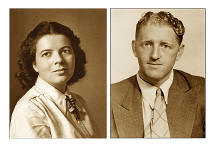
The Rusty Bernstein Memorial Lecture 2005
A SPEECH PREPARED BY AHMED (KATHY) KATHRADA IN MEMORY OF RUSTY BERNSTEIN AND
PRESENTED PRIOR TO THE THIRD RUSTY BERNSTEIN MEMORIAL ADDRESS AT THE UNIVERSITY OF THE WITWATERSRAND, 1st
SEPTEMBER 2005
Thank you very much for inviting me to participate in this annual Rusty Bernstein
Memorial event. In doing so, you have given me the opportunity to reminisce about one of the team of eminent
leaders and thinkers who, with their particular qualities and strengths, made pivotal contributions to our long
march to freedom and democracy. When one looks back to the forties – the period that witnessed the
radicalization of liberation politics in South Africa – Rusty’s name automatically takes its place
among the “A Team” of South African liberation leaders. This team of special people was made up of
leaders like Chief Albert Luthuli; Dr. Yusuf Dadoo; Moses Kotana; Walter Sisulu; J. B. Marks; Nelson Mandela;
Professor Z. K. Mathews; Oliver Tambo; Michael Harmel; Jack Simons; Molvi and Yusuf Cachalia; Bram Fischer;
Ruth and Joe Slovo; Dr. Monty Naicker; and, Ismail Meer.
Any story of Rusty’s life would be incomplete without the role of his wife, Hilda.
On this occasion we shall speak about Rusty, but always bearing in mind that virtually throughout their
political lives their contributions were inseparable.
I first met Rusty in the forties – I was in the Young Communist League and he in
the Communist Party. The picture of Rusty in the forties that sticks indelibly in my mind is of him in army
uniform. He had fought in Italy with the 6th South Army division and had recently returned home. Other comrades
were also returning home from the war – Brian Bunting, Fred Carneson, Wolfie Kodesh, Cecil Williams, Jack
Hodgson, and Joe Slovo. We looked up to them with pride and admiration. They had fought against Nazism and
Fascism in the battlefields of North Africa and Europe and helped to bring about their defeat. Little could we
foresee that within a few short years after the war the South African supporters of the Nazis – some of
whom had been interned in concentration camps for opposing the war – would be elected into power by the
white electorate. One of their election slogans was “Die Kaffers en Boesmans op hul plek en die
koelies uit die land.” This was in 1948.
I thought long and hard when I was asked to speak about Rusty the person. I realized that
it was difficult, if not an impossible task. By his own admission Rusty was not a gregarious person, and
taciturn. He was essentially a family person, a devoted husband and father. His social life was limited to an
occasional party and Saturday afternoon tennis. And that only if he had no pressing political work. For Rusty
was by and large a political animal. Virtually all his adult life he was engaged in politics. He recalled that
at the age of eight he and his school friends played a game in which the two teams were divided into the South
African Party vs. the Labour Party. He joined the Labour party. Still without any political understanding, in
his matric year he took part in a debate on the importance of Science for the future civilization. He chanced
upon a book in the library on the Soviet 5-Year Plan and basing himself on this he helped his team win a
debate. While a student at Wits he was involved in activities on the side of Republican Spain against the
fascist onslaught. It seemed, therefore that from his childhood he was destined to a life of politics.
My over all and lasting impression of him over the years was of a modest man, a simple
man with simple tastes. He was brilliant, a thinker with a profound analytical mind and foresight; he was an
outstanding theoretician, with an ability to explain complex concepts in simple terms. He was above all a
practical man, with his feet firmly on the ground. He was not one for positions in the organization. This is
how he described his approach: -
“I knew that, in many ways I was an unsuitable choice for the post of district
Secretary. My personality was not right for it… The post called above all else for someone
to inspire, galvanize and organise people. I lack the easy rapport with people, the outgoing personality and
the oratory…. I saw myself as eminently replaceable as District Secretary…”
It will not be easy to find politicians who would frankly and openly admit their
shortcomings. In Rusty’s it was modesty rather than inadequacy. I hope I will be forgiven if I talk
mainly about the Rusty I personally knew and remember – and that is Rusty the POLITICIAN.
Exactly a year after the end of the war and while the United Party under the so-called
enlightened General Smuts was still in power, in August 1946 South Africa witnessed the largest and
unprecedented strike by tens of thousands of African mineworkers. The Communist Party threw its weight behind
the African Mine Workers Union. For the duration of the strike Rusty’s responsibility was to
write the daily “Strike Bulletin” and help ensure that it reached the striking mine workers.
The strike was violently crushed by the police, killing about a dozen strikers and
wounding many more. Rusty and the entire Johannesburg District Committee of the Communist Party was arrested
together with a number of other supporters and found guilty of aiding the “illegal” strike. The
accused, numbering just over 50, luckily got away with fines. For the oppressed people of South Africa and the
liberation movement, the 1948 election meant by and a large a change from one racist regime to another. The
difference between the United Party of General Smuts and the victorious Nationalist Party of pro-Nazi Dr. Malan
was summed up by a leading British lawyer, Adv.D.N. Pritt, as follows: -
“If the Nationalist Party proposes to legalise the killing of blacks, the United
Party would move an amendment to limit the length of the blade to three inches”
This view was confirmed soon after the Nationalist Party assumed power. Among the first
pieces of legislation they introduced was one, which outlawed the Communist Party and Communism. Not satisfied
that the penalties were severe enough, the United Party proposed the inclusion of the death penalty for
offenders who were guilty of promoting communism.
Under the circumstances it was logical to find Rusty continuously being actively involved
in every significant campaign, or event following the mine strike of 1946.
Before the 1948 General Elections the Congress organizations held a “Votes for
All” Conference in Johannesburg. It is from about that time that I had the privilege of working closer
with Rusty – firstly at organizational level, and later at committee level. Time will not allow us to go
into details of all the events, but merely list some of the landmark events in which Rusty was a
participant.
On the 1st of May 1950, the Congress and the Communist Party organized a Witwatersrand
– wide strike to protest against the banning of the first lot of prominent leaders. In Sophiatown,
Alexandra Township, and one or two other places, the police opened fire on peaceful gatherings of people who
had not gone to work, killing 18 people and wounding many more.
This led to a National Day of Protest and Mourning on 26th June 1950. Since then the 26th
of June has been etched on the Calendar of the Congress movement to commemorate a milestone in the Freedom
Struggle. The Defiance Campaign of 1952 and the Congress of the People of 1955 are examples of important events
that were launched on the 26th June. The Defiance Campaign was organized by the African National Congress and
the South African Indian Congress. Volunteers were called upon to defy 6 apartheid laws. Close to 10 000
volunteers in different parts of the country were jailed.
The Government responded with drastic legislation in order to crush the strike and the
Congress decided to call off the campaign. Inspired by the campaign, several hundred white sympathizers
gathered in Johannesburg and formed the Congress of Democrats, to join the alliance of the African, Indian and
coloured Congresses. Rusty was elected onto the leadership. In 1954 Rusty was among the scores of leaders who
were banned from taking part in political activities. A second ban prohibited him from attending gatherings.
However, the bans did not mean that Rusty was now going to retire from politics. In his own words again:
-
“Citizens of more democratic countries are predisposed to obey the law; South
Africa’s political activists were predisposed not to. The law had been subverted from a code of public
order into an instrument of minority power. It had forfeited all respect. Conscience dictated that we break our
bans as necessary, and continue whatever political work could be done without endangering others” P.
153.
A year into his banning order the congress convened the Congress of the People. All
significant political organizations, as well as non-Governmental organizations were invited. Needless to say
the ruling Nationalist Party, the opposition United Party and even the Liberal Party refused to attend.
Congress volunteers throughout the country embarked on a campaign to collect the
people’s demands for a Freedom Charter. Rusty was in a Committee whose first task was a draw up a
document which the volunteers would go to the people, inviting them to formulate their demands. Rusty drafted
the document called “Let us speak of freedom”. It became the keynote of the campaign, but much more
important tasks lay ahead. The volunteers collected thousands of demands; many more came by post. It was again
the Committee’s task to sift through the mound of paper and formulate them into the freedom Charter.
Again, Rusty was asked to make a draft for the Committee. After discussion it was approved and passed on to the
Congress Organisation. They in turn unanimously approved it; and it was put to the 3000 delegates to the
Congress of the People and approved with great enthusiasm.
This year we celebrate 50 years of the Freedom Charter. As it is well – known its
main principles were embodied in the Constitution of South Africa. As we celebrate the anniversary of the
Charter and proudly speak of our Constitution that is hailed throughout the world, it is only proper that we
remember and pay tribute to the responsible Committee, and ultimately to the man who crafted this historic
document.
In December of 1956, 156 Congress leaders and activists from all over South Africa were
arrested, brought to Johannesburg and charged with High Treason. The charge was based on the Freedom Charter,
which was alleged to be a Communist document and its fulfillment was to be achieved by violent means. Rusty was
among the accused, but fortunately for him he did not have to sit through the four-and-a-half years, at the end
of which the remaining thirty accused were acquitted by the Special Court of three Judges. The Prosecuting
team, which included the Nazi – admirer, Oswald Pirow, literally scraped the barrel to present evidence.
Just one example will give you an idea. This star witness, reportedly an expert on Communism, pronounced on
scores of documents in the State case and dismissed them as “undiluted Communism”, “straight
from the shoulder Communism” etc. In cross examination the defence Advocate Isie Maisels, asked the
learned Professor’s opinion on several documents, without disclosing the authors. Almost all of them
– including the doctoral thesis of Dr. Piet Koornhof; writings of Gandhi, Churchill etc, were dismissed
by him as “Communism”. Finally a document was put to him, which he described in the same way. Asked
if he knew who the author was; he said he didn’t. “Would it surprise you Professor Murray, if I
told you that you were the author.”!!
In 1960, after the Sharpeville massacre, thousands of people were detained.
Rusty experienced another bout of imprisonment. 1962 witnessed the introduction of the
harshest pieces of legislation aimed at the liberation movement. Among other things it provided for detention
in complete solitary confinement for three months at a time, renewable. It was under similar detention that
Steve Biko and scores of others were tortured to death. There was also provision for house arrest. For some
reason the then Minister of Justice named in advance, a number of politicians who would be victims of house
arrest. Rusty’s name was among them. The House arrest order confined him to his house from 6 p.m. till 9
a.m. the following day, as well as weekends. He was not allowed to have visitors even in his own house.
Rusty’s brother and his wife, urged him to leave the country. Hilda too was so inclined, but left the
decision to Rusty. Rusty’s reaction came as no surprise. It once again demonstrated the calibre, the
devotion and courage of the man.
“I tried to explain why I could not agree to leave. It was neither simple
obstinacy nor fear of losing face. The thing was I had helped create the situation, which confronted us. I had
myself persuaded men and woman to risk their necks for the cause. Leaving now would be like deserting them,
though staying would do nothing to save them… I had given the whole of my adult life to the cause of a
new and better South Africa… I had invested in it everything I had – peace, tranquillity,
prosperity and reputation… I was incapable of just drawing a line under it and writing it off as a bad
investment from which I could walk away. It represented most of what I valued in my life. I would hang on to it
to the bitter end…” (P242)
House arrest virtually converted the victim’s house into a prison. I n the face of
hardship and danger, Rusty continued to do his political work. Among other things he remained active as a
member of the Central Committee of the Communist Party. An important document called “ Operation
Mayibuye” was drawn up by the handful of individuals who constituted the High Command of MK, the military
wing of the ANC. It was quite a detailed and controversial document; the gist of which was to transform the
sabotage campaign into the next phase – to guerrilla warfare.
Operation Mayibuye was presented before members of the High Command and some of us were
on the Central Committee. Rusty was opposed to the plans set out in the document and presented a counter
document. By this time all of us who had been underground had left the secret farm in Rivonia where we had been
hiding. Rusty’s document could not be fully discussed because he had to rush home.
Our lawyers and accused alike were delighted when on Judgement Day – the 11th June,
1964, Judge Quarters de Wet found Rusty not guilty and acquitted him.
It has been a privilege for me to join you in remembering this remarkable man and to
celebrate his life and contribution to the cause of democracy in South Africa. Our congratulations to the
Faculty of Architecture for its initiative and our gratitude for helping to preserve and spread the knowledge
about Rusty.
Rusty himself has resorted to the words of Milan Kundera on the importance of remembering
our history and heritage.
“The struggle of man against power is the struggle of memory against
forgetting”.
Ahmed "Kathy" Kathrada, 2005
|